``Where
the Bishop is, there let the multitude of believers be;
even as where Jesus is, there is the Catholic Church'' Ignatius of
Antioch, 1st c. A.D
Feast of St. Peter Martyr
(St. Peter of Verona)
In the early
13th century, Europe was pockmarked by heresies -- among them
Catharism, a form of Manichaeism that posited not one, but two gods:
the good god who made spirit, and the bad god who made the material
world. Even worse, the Cathars associated the bad god with the God of
the Old Testament and with Satan. Human souls, they believed, were
angelic spirits trapped in matter by the bad god, and their only path
to liberation was to renounce the material world and the body. Even
reproduction was seen as evil. And Christ? He was purely illusory.
In 1205, in Verona, St. Peter Martyr -- whom we also know as Peter of
Verona and, rarely, St. Peter of Milan -- was born into a family that
believed this nonsense. In spite
of their heresies, they sent their young son to Catholic schools,
thinking that any of what they perceived as Catholic foolishness he
picked up, they could argue him out of. But they were wrong; Peter came
to not only embrace the Faith fully, he came to be able to defend it as
well. When his Uncle asked him about his lessons, Peter responded with
the Apostle's Creed -- words that would later be on his lips at his
dying breath. He not only recounted the Credo, he defended it to his
Uncle, who grew worried about the direction Peter was
going. But Peter's father shrugged off the Uncle's concerns and later
sent his boy to
study at the University of Bologna.
Bologna was a wild, rather decadent city, but Peter kept his purity and
focused on the things that truly matter. It was clear by the time Peter
was 15: he was born to be a Dominican, a
religious order that was just founded a few years
earlier by St. Dominic. Peter went to
Dominic himself and received the
habit from his very hands. But he would only have him as a director for
a
short time; St. Dominic would die about a year later.
Fr. Butler, in his "Lives of the Saints," describes Peter's approach to
the religious life:
He was assiduous
in prayer; his watchings and fasts were such, that even in his
novitiate they considerably impaired his health; but a mitigation in
them restored it before he made his solemn vows. When by them he had
happily deprived himself of his liberty, to make the more perfect
sacrifice of his life to God, he drew upon him the eyes of all his
brethren by his profound humility, incessant prayer, exact silence, and
general mortification of his senses and inclinations. He was a
professed enemy of idleness, which he knew to be the bane of all
virtues. Every hour of the day had its employment allotted to it; he
being always either studying, reading, praying, serving the sick, or
occupying himself in the most mean and abject offices, such as sweeping
the house, etc., which, to entertain himself in sentiments of
humility, he undertook with wonderful alacrity and satisfaction, even
when he was senior in religion.
But the Dominican Order is the Order of Preachers, and it is in
preaching
that Peter stood out. He devoted himself to defeating the Catharist
heresy that tainted his family's thinking, and travelled all over
Tuscany, Marche,
Emilia-Romagna, Lombardy and other
parts of what is now Italy to achieve his goal.
Meanwhile, he was blessed with visits from various Saints, including
the Blessed Virgin, who spoke to him the same words her Son used when
speaking to the Apostle Peter at the Lasst Supper (Luke 22:32): "I have
prayed for thee, Peter, that thy faith may not fail; and thou shalt
confirm thy brethren in it." He was also visited by
SS. Catherine, Agnes, and Cecilia. Once, the three were visiting him
in his cell -- and their feminine voices were overheard by his
religious brothers. Then the nightmare began: he was accused of
admitting
strangers into his cell -- including women. As punishment, he was
forbidden from
preaching, and banished to a little convent in Ancona. He bore
this injustice with grace, of course, and when he was ultimately
cleared of wrongdoing, was
restored to former position as preacher.
The equanimity with
which he bore that humiliation must have granted him great favor with
God, because soon he was performing miracles by the power of God.
Healings and exorcisms, especially, caused the people to love him, and
his fame grew. Some of his more famous miracles:
Once, a boy went
to him for confession and repented of kicking his mother. St. Peter
Martyr reminded him of the words of Mark 9:44: "And if thy foot
scandalize thee, cut it off. It is better for thee to enter lame into
life everlasting, than having two feet, to be cast into the hell of
unquenchable fire." The boy took those words very literally, and cut
off his own foot. St. Peter healed his injury.
During one great
preaching event in Milan on a blistering hot, clear day, heretics in
the crowd challenged him with words to this effect: "Oh, Peter, if your
God is true, why would He allow the Catholics in this crowd to faint
and die from this awful heat?" Peter challenged them: "If you promise
to give up your heresies, I will pray to God for relief." They agreed.
Peter then made a great sign of the Cross in the air, and, says the
Golden Legend, "a cloud came and overspread them like a pavilion that
there were assembled, and abode as long as the sermon endured, and it
stretched no further but there."
A lame man was
brought to him in a wheelbarrow. St. Peter made the Sign of the Cross
over him, and the man was healed.
A man whose
throat was so diseased he couldn't speak and had a hard time breathing
was healed when Peter made the Sign of the Cross over him and placed
his cope over his throat. The same man got deathly ill later and was
healed again by Peter in the same way, this time with his cope over his
chest. A great worm was expelled from his body.
A mute man was
brought to Peter, who placed his finger in the man's mouth, healing him
instantly.
He healed a
woman who'd lain sick for seven years.
On one occasion,
he went to visit a friend who had always hosted him with great
hospitality. This time, though, the friend was reluctant to see him.
Peter asked him to explain himself and was told that he'd met with the
Cathars and had an encounter with the Blessed Virgin and, so, decided
to become a Cathar himself. Peter told him to tell his Cathar friends
that he, Peter, would himself become a Cathar if the Blessed Virgin
told him to. At hearing this, the Cathars, thrilled, invited Peter to
one of their meetings. There, one of the Cathars prayed and caused the
"Blessed Virgin" to appear. Peter had come prepared, though: he pulled
from a pyx a consecrated Host, held it up, and told "the Virgin": "If
you are truly the Mother of God, adore thy Son!" The demonic "Blessed
Virgin" instantly disappeared.
The Pope made him Inquisitor General, a move that enraged the
already angry Cathars against whom he'd been so succesful. In response,
the heretics
decided to be rid of him permanently; they hired two assassins: Carino
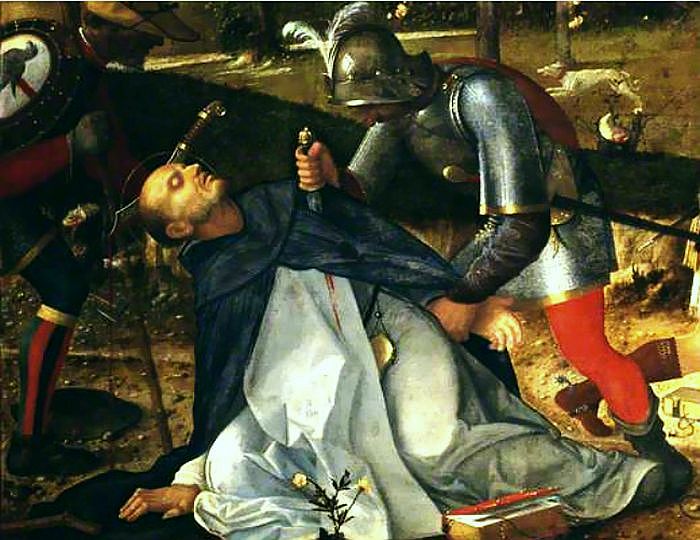
and Alberto. On April 6, 1252, the two went to work, lying in wait
for him along the road that led from Como to Milan. When Peter and a
fellow religious appeared,
Carino struck at Peter's head with his sword, and then struck Peter's
companion. Alberto ran off in fear, and Peter fell to the ground,
uttering some of Christ's last words: "Into Thy hands, O Lord, I
commend my spirit." Then he dipped his fingers into his own blood and
starting writing the first words of the Apostle's Creed he'd learned so
long ago: "Credo in Unum Deum..." Carino then drew a dagger and plunged
it into Peter's chest. It was over. Temporally speaking.
The following from St. Peter's Bull of Canonization describes what
happened perfectly:
[A] wolf against
a lamb, the savage one against the meek, the impious against the pious,
the raging against the gentle, the unbridled against the restrained,
the profane against the sacred, consumed wiht insults, trained in
struggle, eager for death; and attacking that sacred head, he sated his
sword on the blood of the just man. Dreadful wounds inflicted upon him,
he did not turn from the enemy, but immediately showed himself as an
offering (to God), [he expired, sending his spirit to the heavens]
sustaining his patience in the awful blows of the butcher; laid low in
the place of his suffering, (he lay dead).1
But the wolf could not stop the lamb, not even by brutal murder:
the miracles continued after his death. Fr. Butler tells us that
the "history of miracles, performed by his relics and intercession,
fills twenty-two pages in folio in the Acta Sanctorum, by the
Bollandists..." Among his more famous posthumous miracles is his
saving a
ship of pilgrims from sinking.
St. Peter Martyr was canonized in less than a year, the fastest
canonization in history. He was canonized even before his spiritual
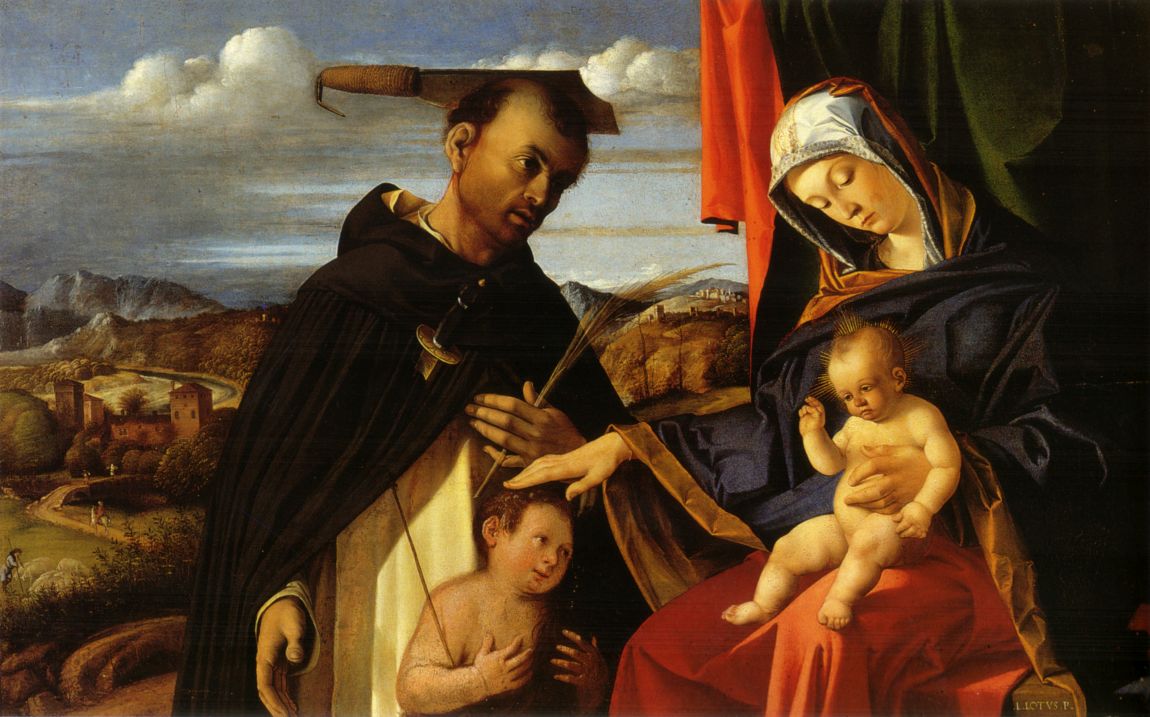
father, St. Dominic, was. He is the Saint to pray to especially when
enduring headaches, and can be recognized in art by the sword or axe
through or over his head, a dagger in his chest, a wounded head, the
palm of martyrdom,
and his Dominican habit. His feast is traditionally celebrated on April
29, but it is kept on the date of his death -- April 6 -- per the new
calendar. The Dominican Order also honors him on June 4.
The relics of St. Peter can be venerated in
the Portinari Chapel of the
Basilica of Sant'Eustorgio in Milan2 His body rests in a
great ornate
ark made of Carrara marble and fashioned by Giovanni di Balduccio in
the early 14th century. The ark is sculpted to depict events of the
Saint's life and miracles. Fellow Dominican St.
Thomas Aquinas visited his tomb in 1263, and a poem he wrote for
St. Peter is inscribed there:
Praeco, lucerna,
pugil Christi, populi, fideique,
Hic silet, hic tegitur, jacet hic mactatus inique.
Vox ovibus dulcis, gratissima lux animorum.
Et verbi gladius gladiis cecidit Catharorum.
Christus mirificat, populus devotus adorat,
Martyrioque fides sanctum servata decorat.
Sed Christus nova signa loqui facit, ac nova turbae
Lux datur, atque fides vulgata refulget in urbe.
Here silent is
Christ’s Herald;
Here quenched, the People’s Light;
Here lies the Martyred Champion
Who fought Faith’s holy fight.
The voice the sheep heard gladly,
The light they loved to see
He fell beneath the weapons
Of graceless Cathari.
The Saviour crowns His Soldier;
His praise the people psalm.
The Faith he kept adorns him
With Martyr’s fadeless palm.
His praise new marvels utter,
New light he spreads abroad
And now the whole wide city
Knows well the path to God.
The Upshot: The Wolf
Becomes a Lamb
After the crime, St. Peter's assassin, Carino, was almost immediately
captured by a nearby farmer. He was put in jail, of course, but was
helped to escape ten days later -- with the help of powerful local
Cathars, rumor at the time said. He eventually wound up in a town
called Forli, exhausted, troubled, and physically ill. He entered a
hospital named after Saint Sebastian there, thinking he was close to
death. Facing his mortality in this way caused him to repent, and he
confessed his sins to the Dominicans who tended to the sick at St.
Sebastian's. He recovered his physical health, and the Dominicans,
believing he was genuine in his sorrow for his sins, allowed him to
become a penitent associated with their Order. For the next 40 years,
he served as a penitent, helping the friars with their work, living
humbly, and devoting himself to contemplation and solitude. He died in
1293, having earlier asked to be buried in a field reserved for the
burial of criminals. The Dominicans followed his wishes, but the people
of Forli had grown to love Carino, who is now considered a Blessed.
They asked the friars to move his remains to a chapel of the priory's
church, and they did. In 1934, his head was moved to his hometown of
Balsamo.
Customs
Some may prepare for this feast by praying a Novena to St. Peter Martyr
starting on April 20 and ending on April 28, For the feast itself there
is today's Collect:
Grant we beseech
Thee, O almighty God, that we may honor the faith of blessed Peter, Thy
martyr, with fitting devotion, as he by the spread of the same faith
was found worthy to obtain the palm of martyrdom. Through Christ our
Lord.
In Milan, his feast is celebrated in a big way. The Ambrosian Rite that
prevails in Milan has a number of interesting traditions for the day:
the skull of St. Peter is displayed in a reliquary, and other relics
are presented to the faithful to be kissed and venerated. During the
liturgy, the word CREDO ("I believe" -- the first words of the
Apostle's Creed uttered and written by St. Peter as he lay dying) is
written on a
paper globe and burned on on a wrought-iron grate held by two angels
above the altar at Mass. And members of the Misericordia
confraternity gather. This association was instigated by St. Peter
Martyr to help care for the sick, and today they run ambulance
services, all for free. New members of the confraternity are given
their black robes of penitence, a black mask, and a rosary which are
blessed during the liturgy today.
The Roman Rite also has unique traditions for the day -- the blessing
of palms and of water.
The palms are taken home by the faithful, shaped into Crosses, and
buried in each of the four corners of
their property to ward off evil and keep their land and home safe from
inclement
weather. The water -- Peter Martyr Water -- is kept to be given to the sick to sip or to apply
to ailing body parts. The blessings:
The blessing of
palms:
V: Our help is
in the name of the Lord.
R: Who made heaven and earth.
V: The Lord be with you.
R: And with your spirit.
Let us pray. Lord Jesus Christ, Son of the living God, we beg you to
bless + these tree-branches, to pour out on them a heavenly blessing,
by the power of the holy + cross and the prayers of St. Peter Martyr;
for when you once went forth to triumph over the enemy of mankind, you
willed that little children pay honor to you, waving palms and
tree-branches before you. By the sign of the holy + cross, let these
branches be so endowed with your blessing, that wherever they are kept
the prince of darkness with all his followers may flee in fear and
trembling from such homes and places; no damage may be done there from
lightning and storm; no inclement weather consume or destroy the fruits
of the earth; no happening disturb or molest those who serve you, the
almighty God, who live and reign forever and ever.
R: Amen.
They are sprinkled with holy water.
V. Adjutórium
nostrum in nómine Dómini.
R. Qui fecit caelum et terram.
V. Dóminus vobíscum.
R. Et cum spíritu tuo.
Orémus. Dómine Jesu Christe, Fili Dei vivi, bene+díc hos árborum ramos
supplicatiónibus nostris et infúnde eis, Dómine, per virtútem Sanctae
Cru+cis et per intercessiónem beáti Petri Mártyris, benedictiónem
caeléstem, qui triumphatúrus de hoste géneris humáni per manus puerórum
palmas et árborum ramos in honórem tuum ahibére voluísti, talémque
benedictiónem signáculo Sanctae Cru+cis accípiant: ut, in quibuscúmque
locis áliquid ex eis pósitum fúerit, discédant príncipes tenebrárum et
contremíscant et fúgiant pávidi cum ómnibus minístris suis de locis vel
habitatiónibus illis. Non ibi nóceant fúlmina et tempestátes, non
fructus terrae consúmat aut depérdat ulla intempéries eleménti,
nihílque inquiétet aut moléstet serviéntes tibi omnipoténti Deo. Qui
vivis et regnas in saécula saeculórum.
R. Amen.
Aspergantur aqua benedicta.
The blessing of
water:
V: Our help is
in the name of the Lord.
R: Who made heaven and earth.
V: The Lord be with you.
R: And with your spirit.
Let us pray. God, who for man’s salvation instituted the most wonderful
mysteries in the element of water, hearken to our prayer, and pour
forth your blessing + on this element, water, which we now make holy in
the name of St. Peter the Martyr. By the intercession of this martyr of
yours let it prove a salutary remedy for your faithful, driving out
evil spirits and warding off illness and suffering of body and spirit.
May all who drink of it or are sprinkled with it be delivered from
every affliction of body and soul and regain health in their whole
being; through Christ our Lord.
R: Amen.
Let us pray. Almighty
everlasting God, we humbly appeal to your mercy and goodness to
graciously bless + by your indescribable power these your faithful
people, who come to venerate the relics of St. Peter Martyr and beg his
intercession. Delivered by your martyr’s prayers from every affliction
of mind and body, protected by your mercy here and everywhere, and
saved by your grace, may they deserve, after this life has run its
course, to attain the joys that are unending; through Christ our Lord.
R: Amen.
V. Adjutórium
nostrum in nómine Dómini.
R. Qui fecit caelum et terram.
V. Dóminus vobíscum.
R. Et cum spíritu tuo.
Orémus. Deus, qui ad salútem humáni géneris máxima quaeque sacraménta
in aquárum substántia condidísti, adésto propítius invocatiónibus
nostris, et eleménto huic aquae, quod beáti Petri Mártyris tui virtúte
consignámus, virtútem tuae bene+dictiónis infúnde: ut, per intervéntum
ejúsdem Mártyris tui, sit fidélibus tuis in remédium salutáre, daémones
ab eis ejíciens, morbos ac infirmitátes córporis et ánimae repéllens,
et praesta, ut, quicúmque eam súmpserint, vel ea aspérsi fúerint, ab
omni adversitáte ánimae et córporis liberéntur et utriúque hóminis
recípiant sanitátem. Per Christum Dóminum nostrum.
R. Amen.
Orémus.
Imménsam cleméntiam tuam, omnípotens aéterne Deus, humíliter
implorámus: ut hos fidéles tuos, ad relíquias beáti Petri Mártyris
devote accedéntes, et ejus suffrágia postulántes, tua ineffábili
virtúte bene+dícere dignéris, ut, per intervéntum ejúsdem Mártyris tui,
ab omni aegritúdine mentis et córporis liberáti, tuáque hic et ubíque
misericórdia custodíti et grátia salváti, post hujus quoque viae ac
vitae cursum, ad aetérna mereántur gáudia perveníre. Per Christum
Dóminum nostrum.
R. Amen.
As to foods for the day, in some places in Italy (e.g., Seveso),
cookies called falcastrotti are eaten on and around the Saint's feast.
They're shaped like the sword that St. Peter Martyr's assassin used to
kill him, with the blade's edge covered in red icing to resemble the
martyr's blood. I don't have any recipe for them, alas, but do have a graphic you can use for a stencil
(pdf) to make rolled and cut cookies using your own recipes.
One of the best things you can do today is to make sure you and your
children know and understandthe Apostles' Creed
that is so important to St. Peter Martyr's story.
The book "Explanation
of the
Apostles' Creed" (pdf) by Fr. H. Rolfus might be of help to you.
And listening to the Creed set to music certainly can't hurt: Credo in
Deum
(5vv), by Fernando de las Infantas (b. 1534):
Readings
From the Golden Legend
by Jacobus de Voragine, Archbishop of Genoa, 1275
Here followeth the Life of S. Peter of Milan, and first the
interpretation of his name.
Peter is as much to say as knowing or unhosing, or Peter is said of
petros, that is constant and firm, and by that be understood three
privileges that were in S. Peter; he was a much noble preacher, and
therefore he is said knowing, for he had perfect knowledge of
scripture, and knew in his predication what was behoveful to ever each
person. Secondly, he was pure and a virgin, and therefore he was said
unhosing, for he unhosed and did off his will from his feet, and
despoiled all mortal love, insomuch that he was a virgin, and not only
of body but also of mind. Thirdly, he was a martyr glorious of our Lord
and therein he was constant and firm, to the end that he should suffer
steadfastly martyrdom for the defence of the faith.
Of S. Peter of Milan.
S. Peter the new martyr, of the order of the friars preachers, was born
in the city of Verona in Lombardy. His father and mother were of the
sect of the Arians. Then he descended of these people like as the rose
that cometh of the thorn, and as the light that cometh of the smoke. At
the age of seven years, when he learned at the school his credo, one,
his eme, which was a heretic, demanded of him his lesson, and the child
said to him: Credo, till to creatorem cœli et terræ; his uncle said to
him that he should no more say so, for God hath not made temporal
things, the child affirmed that he ought to say none otherwise, but so
as he had learned, and that other began to show him by authority his
purpose; but the child, which was full of the Holy Ghost, answered so
well and wisely that his uncle departed all confused, and all
achauffed, said to the father that he should take away his son from
school, for he doubted when he shall be great that he should turn
against their law and faith, and that he should confound them. And so
it happed, and so he prophesied like as Caiaphas did, but God, against
whom none may do, would not suffer it for the great profit that he
attended of him. Then after, when he came to more age, he saw that it
was no sure thing to dwell with the scorpions. He had in despite father
and mother. and left the world whiles he was a clear and a pure virgin.
He entered into the order of the friars preachers there, whereas he
lived much holily the space of thirty years or thereabout, full of all
virtues and especial in defending the faith, for love of which he
burnt. He did much abstinence for to bring his flesh low, he fasted, he
entended to wake by night in studying and in prayer when he should have
slept and rested, and by day he entended to the profit of the souls, in
preaching, in confessing, and in counselling, in disputing against the
heretics and Arians, and in that he had a special grace of Jesu Christ,
for he was right sore founded in humilty. He was marvellously piteous
and debonair, full of compassion, of great patience, of great charity,
and of steadfastness. So ripe and so well ordained in fair manner that
every man might behold as in a mirror, in his continence and in his
conversation. He was wise and discreet, and so emprinted in his heart
that all his words were firm and stable. Then he prayed many times to
our Lord that he would not let him die but by sufferance of martyrdom
for him and for his faith. And thus as he prayed God accomplished in
the end.
He did many miracles in his life, for in the city of Milan, on a time
when he examined a bishop of the Arians that the christian men had
taken, and many bishops, religious, and great plenty of other people of
the city were there assembled, and was then right hot, this Arian said
to S. Peter tofore them all: O thou Peter perverse, if thou art so holy
as this people holdeth thee for, wherefore sufferest thou this foolish
people to die for heat, and prayest not God that he would shadow them.
Then S. Peter answered and said: If thou wilt promise that thou shalt
hold the very faith and thou wilt leave thine heresy, I shall pray
therefor to our Lord. Then all they that were on the party of the
Arians cried that he should promise him, for they supposed that he
should not get it specially, because the air was so clear and no cloud
was seen, and the christian men doubted that their faith might thereby
come to confusion, but the bishop, the heretic, would not bind him
thereto. S. Peter had good faith and trust in God, and made his prayer
openly that he would convey over them a cloud, and he made the sign of
the cross, and anon the cloud came and overspread them like a pavilion
that there were assembled, and abode as long as the sermon endured, and
it stretched no further but there.
There was a lame man which had been so lame five years and might not
go, but was drawn in a wheelbarrow, and brought to S. Peter at Milan,
and as S. Peter had blessed him with the sign of the cross, anon he was
whole and arose. Yet other miracles God showed for him by his life. It
happed that the son of a gentleman had such a horrible disease in his
throat that he might neither speak ne draw his breath, but S. Peter
made on him the sign of the cross, and laid his cope on the place where
the sore was, and anon he was all whole. The same gentleman had
afterwards a grievous malady and supposed to have died, and made bring
to him the said cope, which with great devotion laid it on his breast,
and anon he cast out a worm with two heads which was rough, and after
he was brought in good health and anon all whole. It happed that a
young man was dumb and might not speak a word, wherefore he came to S.
Peter, and he put his finger in his mouth and his speech came to him
again. Now it happed that time that an heresy began much in Lombardy,
and that there were much people that were fallen in this error, and the
pope sent divers inquisitors thither of the order of the friars
preachers, and because that at Milan there were many in number of great
power and engine, he sent thither S. Peter as a man wise, constant, and
religious, which doubted nothing. And by his virtue he reproved them,
and by his wit he understood their malice, and when he had enterprised
the office of Inquisition, then began he, as a lion, to seek the
heretics over all, and left them not in peace, but in all places,
times, and all the manners that he might, he overcame and confounded
them. When the heretics saw that they might not withstand the Holy
Ghost that spake in him, they began to treat how they might bring him
to death. Then it happed on a time, as he went from Cumea to Milan for
to seek the heretics, he said openly in a predication that the money
was delivered for to slay him. And when he approached nigh the city a
man of the heretics, which was hired thereto, ran upon him and smote
him with his falchion on the head, and gave and made to him many cruel
wounds, and he that murmured not ne grudged not, suffered patiently the
cruelty of the tyrants, and abandoned or gave himself over to suffer
the martyrdom, and said his credo, and in manus tuas, commending his
spirit unto the hands of our Lord. And so the tyrant left him in the
place for dead, and thus told the tyrant that slew him, and friar
Dominic which was his fellow was slain with him. And after, when the
tyrant saw that he removed yet his lips, the cursed and cruel tyrant
came again and smote him with his knife to the heart, and anon his
spirit mounted in to heaven. Then was it well known that he was a very
prophet, for the prophecy of his death that he had pronounced was
accomplished. After, he had the crown of virginity, for as his
confessors witness that in all his life he had never done deadly sin.
After, he had the crown of a doctor, because he had been a good fast
firm preacher and doctor of holy church. After, he had the crown of
martyrdom, as it appeared when he was slain. The renown thereof came
into the city of Milan, and the friars, the clergy, and the people,
came with procession with so great company of people, that the press
was so great that they might not enter into the town, and therefore
they left the body in the abbey of S. Simplician, and there it abode
all that night and so he said the day tofore to his fellow. The passion
of S. Peter ensued much like the passion of our Lord in many manners,
for like as our Lord suffered for the truth of the faith that he
preached, so S. Peter suffered for the truth of the faith that he
defended; and like as Christ suffered of the Jews, so S. Peter suffered
of the people of his own country, and of the heretics; Christ suffered
in the time of Easter, so did S. Peter. Jesu Christ was sold for thirty
pence, and S. Peter was sold for forty pounds. Jesu Christ showed his
death to his disciples, and S. Peter showed it in plain predication.
Jesu Christ said at his death: Lord God, into thy hands I commend my
spirit; right so S. Peter did the same. There was a nun of Almaine, of
the abbey of Oetenbach, which had a grievous gout in her knee, which
had holden her a year long and more, and there was no master ne
physician that might make her whole. She had great devotion to S.
Peter, but she might not go thither because of her obedience, and
because her malady was so grievous. Then demanded she how many days'
journey was from thence to Milan, and she found that there were
fourteen journeys. Then purposed she to make these journeys by her
heart and good thoughts, and she said for every journey one hundred
paternosters. And always as she went forth by her mind in her journeys,
she felt herself more eased, and when she came to the last journey in
her mind she found herself all guerished. Then she said that day all
the Psalter, and after returned all the journeys like as she had gone
by her thoughts in her heart, and after that day she felt never the
gout.
There was a man that had a villainous malady beneath, in such wise that
he voided blood six days continually; he cried to S. Peter devoutly,
and as he had ended his prayer he felt himself all whole; and after he
fell asleep, and he saw in his sleep a friar preacher which had a face
great and brown, and him seemed that he had been fellow to S. Peter,
and verily he was of the same form. This friar gave to him a box of
ointment and said to him: Have good hope in S. Peter which late hath
shed his blood for the faith, for he hath healed thee of the blood that
ran from thee, and when he awoke he purposed to visit the sepulchre of
S. Peter.
There was a countess of the castle Massino, which had special devotion
to S. Peter and fasted alway his vigil; now it happed that she offered
a candle to the altar of S. Peter, and anon the priest for his covetise
quenched the candle, but anon after the candle was light again by
himself, and he quenched it again once or twice, and always as soon as
he was gone, it lighted anon again; then he left that and put out
another candle which a knight had offered in the honour of S. Peter,
which knight fasted also his even, and the priest assayed two times if
he might put it out, but he might not. Then said the knight unto the
priest: What, devil, seest thou not well the miracle, that S. Peter
will not that they be quenched? Then was the priest abashed and all the
clerks that were there with him, in so much that they fled out of the
church and told the miracle overall.
There was a man called Roba which had lost at play his gown and all the
money that he had. When he came into his house and saw himself in so
great poverty, he called the devils and gave himself to them; then came
to him three devils which cast down Roba upon the soler and after took
him by the neck, and it seemed that they would have estrangled him, in
such wise that he unnethe might speak. When they that were in the house
beneath heard him cry, they went to him, but the devils said to them
that they should return, and they had supposed that Roba had said so,
and returned, and after anon he began to cry again; then apperceived
they well that they were the devils, and fetched the priest, which
conjured in the name of S. Peter, the devils, that they should go their
way. Then two of them went away and the third abode, and his friends
brought him on the morn to the church of the friars. Then there came a
friar named Guillaume of Vercelli, and this friar Guiliaume demanded
what was his name, and the fiend answered: I am called Balcefas; then
the friar commanded that he should go out, and anon the fiend called
him by his name as he had known him, and said: Guillaume, Guillaume, I
shall not go out for thee, for he is ours and hath given himself to us.
Then he conjured him in the name of S. Peter the martyr, and then anon
he went his way and the man was all whole, and took penance for his
trespass, and was after a good man.
S. Peter whiles he lived, it happed that he disputed with a heretic,
but this heretic was sharp, aigre, and so full of words that S. Peter
might have of him none audience. When he saw that, he departed from the
disputation and went and prayed our Lord that he would give to him
place and time to sustain the faith, and that the other might be still
and speak not; and when he came again he found this heretic in such
case that he might not speak. Then the other heretics fled all
confused, and the good christian men thanked our Lord.
The day that S. Peter was martyred, a nun that was of the city of
Florence saw in a vision our Lady that styed up to heaven, and with her
two persons, one on the right side and that other on the left, in the
habit of friars, which were by her, and when she demanded who it was, a
voice said to her that it was the soul of S. Peter, and was found
certainly that same day he suffered death, and therefore this nun,
which was grievously sick, prayed to S. Peter for to recover her
health, and he gat it for her entirely.
There was a scholar that went from Maloigne unto Montpellier, and in
leaping he was broken that he might not go. Then he remembered of a
woman that was healed of a cancer by a little of the earth of the
sepulchre of S. Peter, and anon he had trust in God, and cried to S.
Peter in such manner as she had done, and anon he was whole.
In the city of Compostella there was a man that had great legs swollen
like a barrel, and his womb like a woman with child, and his face foul
and horrible, so that he seemed a monster to look on. And it happed
that he went with a staff begging his bread, and in a place where he
demanded on a time alms of a good woman, she saw him so swollen that
she said that it were better for him to have a pit to be buried in than
any other thing, for he was no better than dead, yet nevertheless, said
she, I counsel thee that thou go into the church of the friars
preachers, and pray S. Peter that he make thee whole, and have in him
very faith and I hope he shall make thee all whole. This sick man went
in the morn to the church, but he found it shut and closed. Then he
slept at the door, and he saw in his sleep that a man in the habit of a
friar brought him into the church, and covered him with his cope, and
when he awoke he found himself in the church and was perfectly whole,
whereof much people marvelled because they had seen so short time
tofore, him like as he should have died forthwith. There be many more
miracles which were over great a labour to write all, for they would
occupy a great book. Then let us pray to this holy martyr S. Peter that
he pray for us.
Footnotes:
1 Prudlo, Donald S. “The Assassin-Saint:
The Life and Cult of Carino of Balsamo.” The Catholic Historical Review
94, no. 1 (2008): 1–21. http://www.jstor.org/stable/25166917.
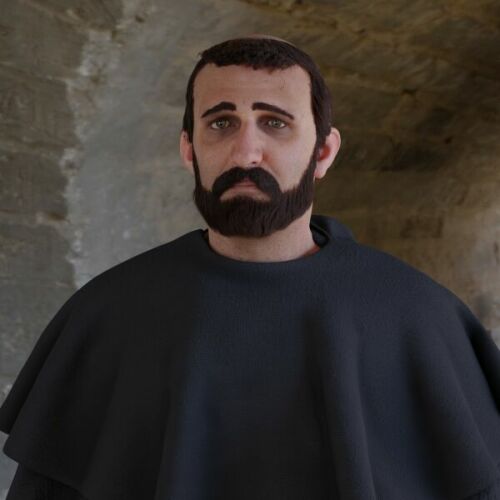
2 Scientists at the Brazilian Team of
Forensic Anthropology and Odontology, using CT scans (tomography) and
3D photogrammetry, studied St. Peter of Verona's skull and made a
reconstruction of his face based on average tissue depths, her
ethnicity, etc. They believe this is how he looked in life: